
When your body attacks itself, the hardest part is being believed.
The symptoms are real. Now look deeper than symptoms — at the genetic information beneath them, read with a physician and a genetic counselor by your side.
See how it works
avg. 4 years · 4 specialists · before an answer. It shouldn't take that long.


The scale of it
Autoimmune disease is more common than most people realize.
It's one of the largest categories of chronic illness in the world — and it's growing.

And the numbers are rising. The most common marker of autoimmunity in the population has climbed sharply in recent decades, with the steepest increases seen in adolescents. This isn't a niche concern — it's a defining health challenge of our time.
The genetic story
Autoimmune disease is written, in part, in your genes.
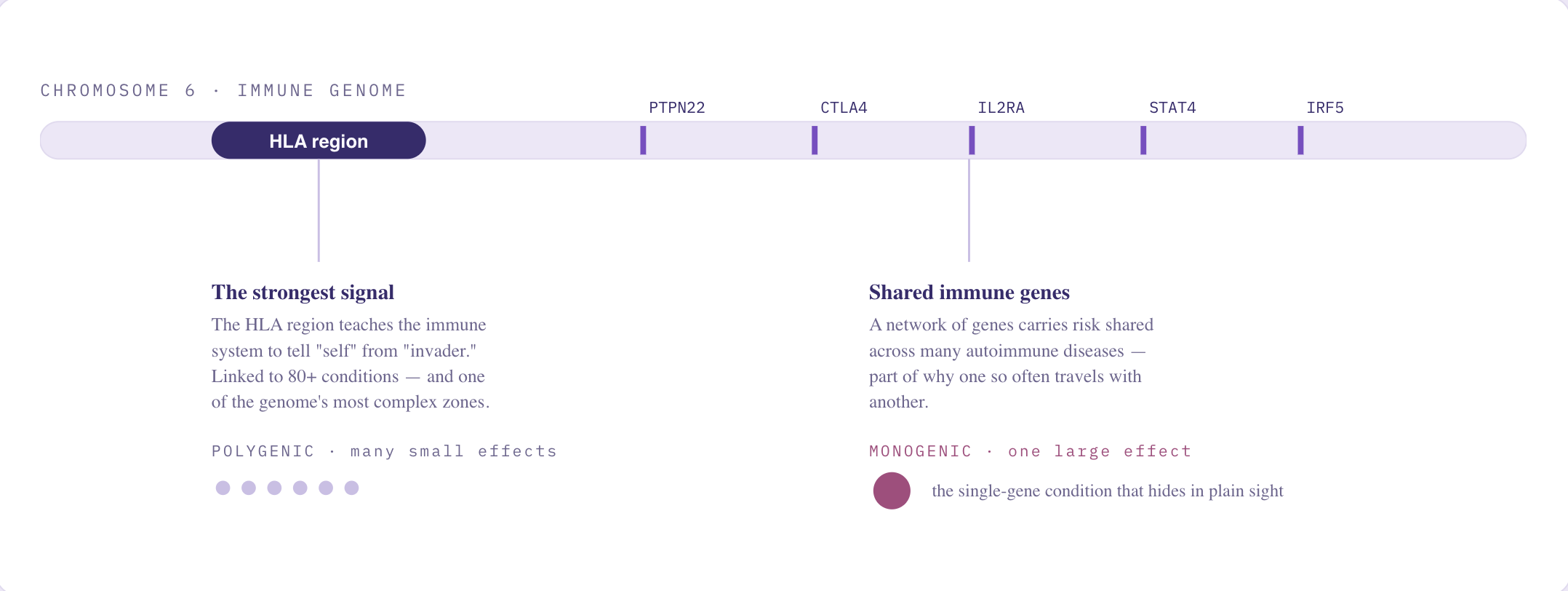
These conditions arise from genetic predisposition meeting environmental triggers. The genetic side of that equation is significant — and it lives in three places.
01 · HLA
The strongest influence
Specific HLA variants are associated with susceptibility across more than 80 conditions — and this region is so complex it's routinely missed by ordinary tests.
02 · Shared genes
Risk that travels
PTPN22, CTLA4, IL2RA, STAT4, IRF5 and others carry risk shared across many autoimmune diseases, which helps explain why they cluster.
03 · Monogenic
Hiding in plain sight
In a meaningful minority, a single gene is the driver — a condition that can mimic lupus, vasculitis, or Behçet's and be mislabeled for years.
Why people choose this test
Information you and your care team can actually use.
Bring clarity to a long search
WGS looks underneath the symptoms at the genetic factors that may be involved — giving your physician and counselor more to work with, earlier.
Understand your genetic context
For you, or a relative wondering if they're next. Your genetic counselor helps you understand what that context does — and doesn't — mean.
Surface rare conditions that are easy to miss
Sequencing can reveal single-gene conditions that mimic common diagnoses, so your physician can review whether they fit your picture. Standard blood panels aren't designed to look for this.
The genome provides the information. Your care team provides the judgment.
A care team behind every result
Not a mail-in kit you decode alone. Physician-ordered, CLIA/CAP-analyzed, and reviewed with a genetic counselor who explains what it means for you.
Connect the dots
Joints, skin, gut, thyroid, nerves — usually seen separately. Genetics explores whether one biological thread may connect symptoms treated as unrelated.
Open doors
A finding can connect you with specialized clinics, condition experts, research programs and trials, and patient communities.
Why whole genome sequencing
Most tests read a sliver. WGS reads nearly all of it.
Autoimmune risk is spread across the HLA region, shared immune genes, and rare single-gene conditions — all at once. A narrow test can't see that whole picture.
01
The complete immune genome
Complete HLA typing, the shared immune-regulatory genes, and the single-gene disorders that mimic common ones — read directly, not estimated the way arrays do.
02
One test. Lifelong value.
Your DNA doesn't change. As science advances, your data can be revisited — without starting over, without another test, without another wait.
03
Built for a fast-moving field
New disease-gene associations arrive every year. WGS is a lasting genomic resource that can grow more valuable over time.
How it works
A clinical process, from order to answer.

Does this sound familiar?
The symptoms that deserve a real explanation.
Especially several at once, or symptoms that come and go — they're worth understanding at the deepest level.
Persistent, unexplained fatigue
Skin rashes, sensitivity, hair loss
Muscle aches and weakness
Joint pain, stiffness, swelling
Digestive problems, food intolerances
Thyroid irregularities
Symptoms tell you something is going on. Your genome, read with your care team, can help explain why.
Recurring fevers or flu-like episodes
Brain fog, numbness, tingling
A family history of autoimmune disease
Honest by design
What this test can — and can't — tell you.
Whole genome sequencing is powerful, but it's not a crystal ball. Clarity builds trust.
IT CAN
Identify genetic variants associated with autoimmune and immune-related conditions
Surface rare single-gene conditions for your physician to evaluate
Give your care team richer information, interpreted with counseling
IT CAN’T
Diagnose autoimmune disease on its own
Find a genetic explanation in everyone — most disease is polygenic
Turn a risk variant into a certainty, or rule disease out entirely
That's exactly why every result is reviewed with your physician and a genetic counselor, who place it in the context of your health and history.
Knowledge creates confidence
When your body has spent years being questioned, you deserve to be taken seriously.
Understand your own biology as completely as today's science allows — and give you and your care team clearer information to move forward with.
Physician-ordered · CLIA-certified · CAP-accredited · Genetic counseling included
Important Notice
This whole genome sequencing service is physician-ordered and performed in a laboratory certified under the Clinical Laboratory Improvement Amendments (CLIA) and accredited by the College of American Pathologists (CAP). It is intended to provide genomic information to support your care — not to serve as a standalone diagnosis. Genetic testing does not identify every cause of autoimmune or immune-related conditions, and results describe genetic associations and possibilities rather than certainties. Your ordering physician and a genetic counselor will review your results with you and help determine what they mean for your health. Always discuss medical decisions with your healthcare provider.
Sources
Prevalence figures: Fairweather D., Abend A.H. et al., Journal of Clinical Investigation (Dec 2024), summarized by Mayo Clinic News Network. Diagnostic-journey figures: American Autoimmune Related Diseases Association (AARDA) / Autoimmune Association patient surveys; Benaroya Research Institute. Rising-prevalence figure: National Health Council. Keep this documentation on file to substantiate the claims shown.